How much buffer time should you leave between grooming appointments for different breeds?
Padding your schedule is a tradeoff between calm days and lost revenue. Here is a way to set buffers by breed, coat, and service instead of guessing.
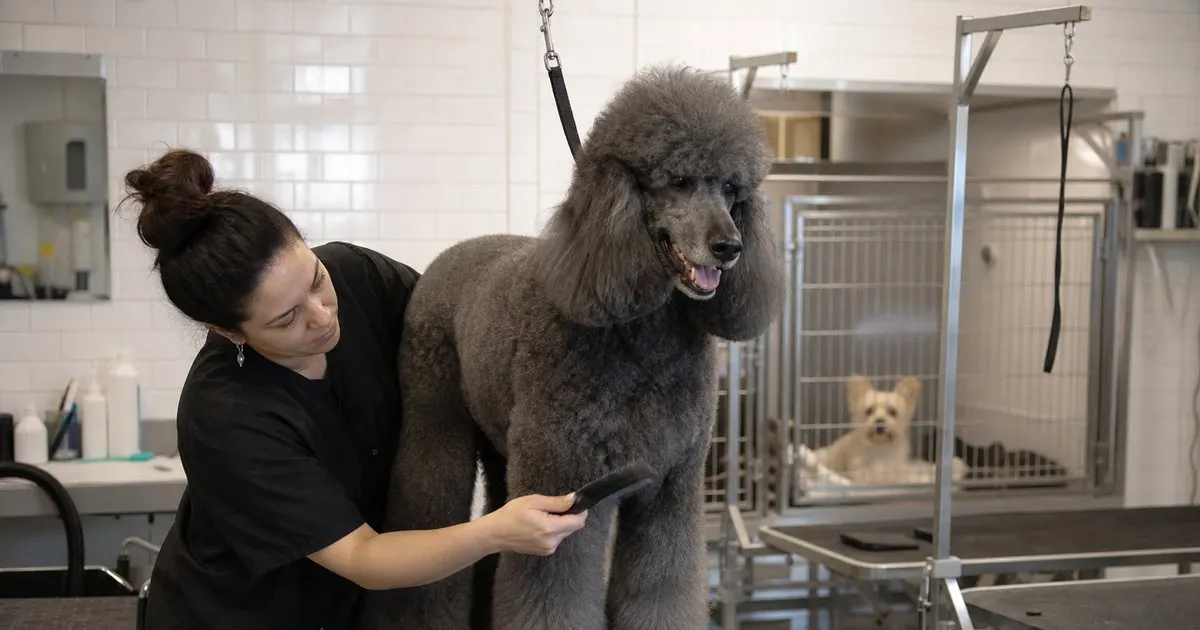
Why a single default buffer fails
Most booking tools let you set one buffer that applies to every appointment, and many groomers set it to a single round number, often somewhere around fifteen minutes, and forget about it. That works for a schedule of similar dogs. It breaks the moment a matted doodle lands between two bath-and-tidy appointments, because the doodle runs long, the next client waits in the lobby, and the day never recovers. A single buffer is really a bet that every appointment has the same variance, which is not true in grooming. Related: Why Online Booking Helps Grooming Businesses
The better way to think about it is that buffer time exists to absorb two things: the cleanup and reset between pets, and the difference between your estimate and reality. Cleanup is fairly constant. Estimation error is not. A short-coated dog you have groomed ten times has almost no estimation error. A first-time visit from a large double-coated breed with an unknown temperament has a lot. Buffers should follow that variance.
Keep reading: Why Online Booking Helps Grooming Businesses, Keeping Vaccination Records That Protect You, Reducing No Shows in Grooming. See how GroomBookr helps you grooming appointments plus a pet vaccination record vault.
Setting durations by breed and coat, then buffers on top
Start by writing down honest durations for your own work, not the averages you have seen quoted elsewhere. Time yourself over a couple of weeks on the services you do most: bath and brush for a short coat, full haircut for a small curly coat, de-shedding for a large double coat, and so on. Your numbers will differ from another groomer's because of your speed, your equipment, and whether you have a bather. Once you have durations you trust, group breeds and coat types into a handful of duration tiers rather than trying to maintain a per-breed list.
Then set buffers per tier. Short, predictable services can carry a small buffer that mostly covers sanitizing the table and tools. Long or high-variance services should carry a larger one, and first visits should carry the largest, because you have no history to estimate from. A reasonable starting point, before your own data corrects it, is three bands. A short reset of roughly 10 to 15 minutes after quick services on known pets: a nail trim, a bath and brush on a short-coated breed such as a beagle, boxer, or Labrador, or a tidy on a regular whose last few visits ran on time. A medium band of roughly 20 to 30 minutes after full haircuts on cooperative regulars, which covers most small and medium curly and drop coats such as poodle mixes, shih tzus, and cocker spaniels, where drying and finish work add variance. The longest band of roughly 30 to 45 minutes, and sometimes more, after a first visit of any breed, a de-shedding on a large double coat such as a husky, golden retriever, or Newfoundland, a doodle that arrives with any matting, and any dog with a behavior flag on its profile. Treat those minutes as a place to start rather than a rule. Your own timed work should replace them within a few months, and what matters most is that the bands differ from each other.
Using pet history to shrink the buffer over time
The most valuable data you have is how long each specific pet actually took last time. If your intake notes record start and finish, you can look at a returning pet and see that the doodle booked as a two-hour groom finished in ninety minutes on the last three visits. That pet no longer needs a first-visit buffer. Conversely, a dog whose notes say it needed two breaks and a muzzle should keep a larger buffer no matter what breed it is.
This is where pet profiles earn their keep in scheduling, not just in service quality. When a booking pulls up the last recorded duration and any behavior flags, the front desk can set a realistic slot without asking the groomer to interrupt a haircut. GroomBookr stores those notes with the pet, and any system that lets you log actual time against the booked time will let you tighten buffers safely. The goal is that your buffers reflect what you know, and shrink as you know more. Related: Pet Profiles and Better Service
Protecting the day when a buffer is not enough
Buffers absorb small overruns. They do not absorb a dog that arrives with pelted mats when it was booked as a trim. For those cases you need a policy in front of the buffer: a check-in assessment that takes a minute or two, and permission to re-quote and re-time the appointment before the pet goes on the table. If the new duration does not fit the day, the honest move is to offer a rebook or a partial service, rather than pushing every later client back an hour. Related: What should a groomer do when a client's rabies certificate has expired at check-in?
It also helps to leave one intentionally empty slot in the middle of each day, at least on days with several new clients. It feels like lost revenue on the calendar. In practice it gets used almost every day by an overrun, a walk-in nail trim, or a groomer who needs a real lunch. If it goes unused, you finish early, which is not a bad outcome. Treat that slot as part of your buffer strategy and stop apologizing for it. Related: When should a mobile groomer stop booking by text message and use real scheduling software?
- One buffer for every appointment assumes equal variance, which is false in grooming.
- Set durations from your own timed work, group them into tiers, and attach a buffer to each tier: roughly 10 to 15, 20 to 30, and 30 to 45 minutes as a starting point.
- Use recorded actual durations and behavior flags per pet to shrink buffers for known dogs.
- Keep a check-in assessment and one open slot per day for the cases a buffer cannot absorb.

Julien Jimenez
Julien Jimenez is an independent software builder based in Paris. He designs, ships, and operates focused SaaS products for small businesses and independent professionals. Read the full author page.
Bookings and vaccination records in one place
Grooming appointments plus a pet vaccination record vault. GroomBookr is built to help you put this into practice.
Take bookingsMore from the GroomBookr blog
Why Online Booking Helps Grooming Businesses
Keeping Vaccination Records That Protect You
Reducing No Shows in Grooming
Get the GroomBookr playbook
Practical guides on pet grooming, straight to your inbox as we publish them. No spam, unsubscribe any time.